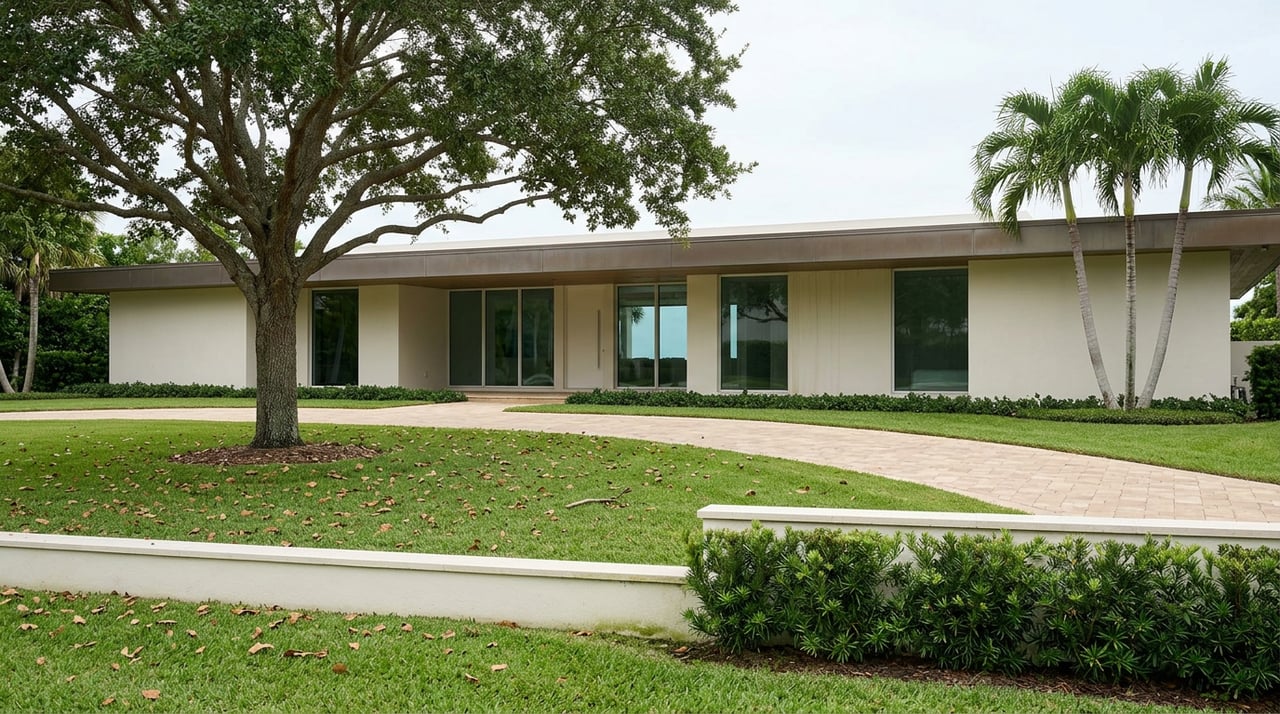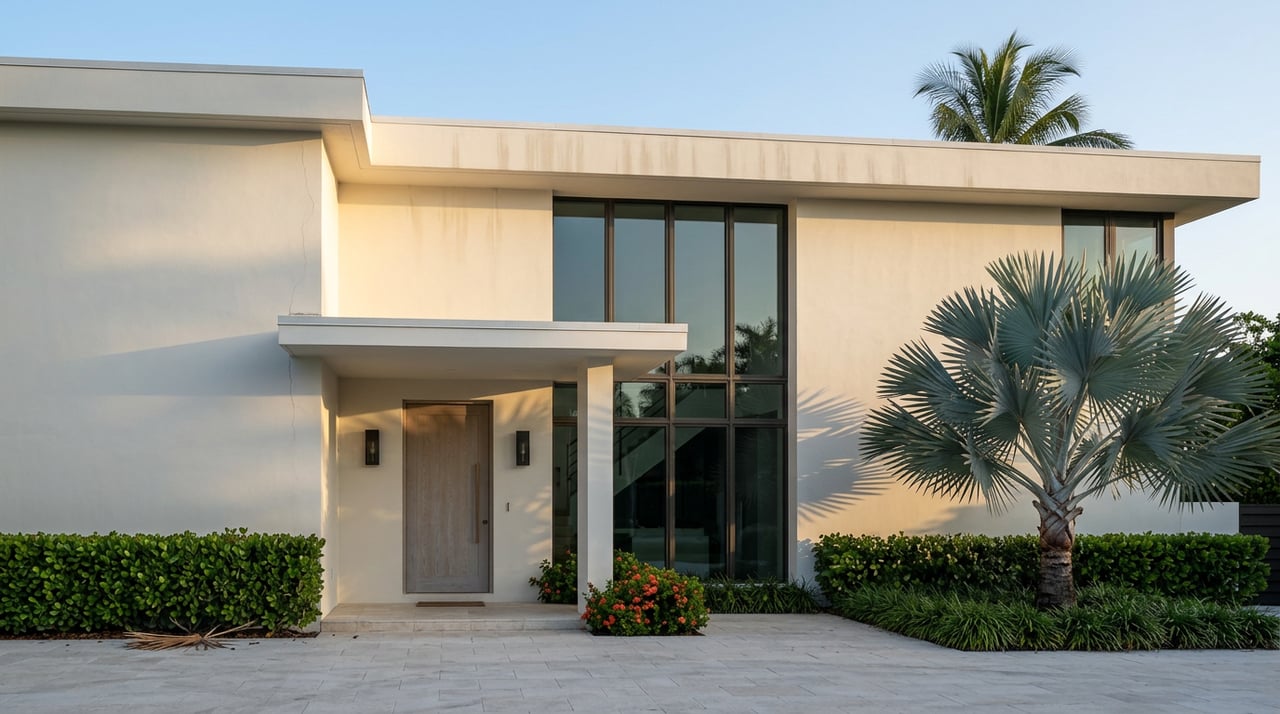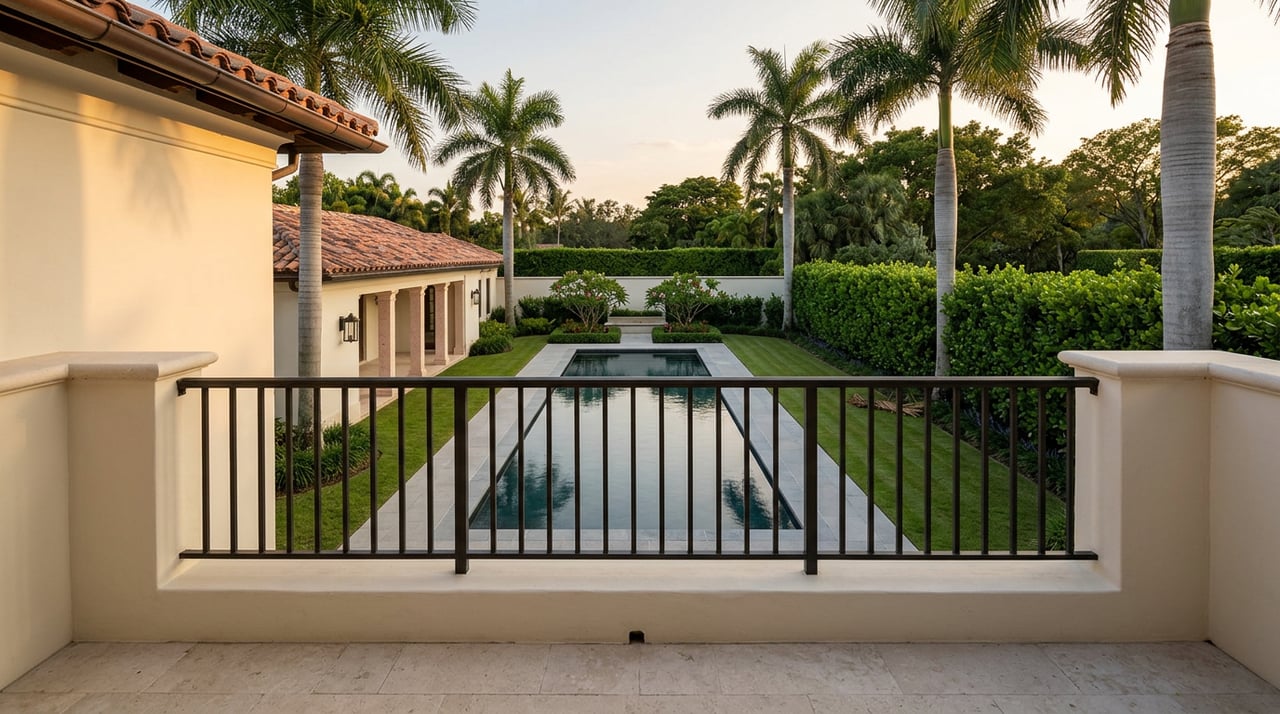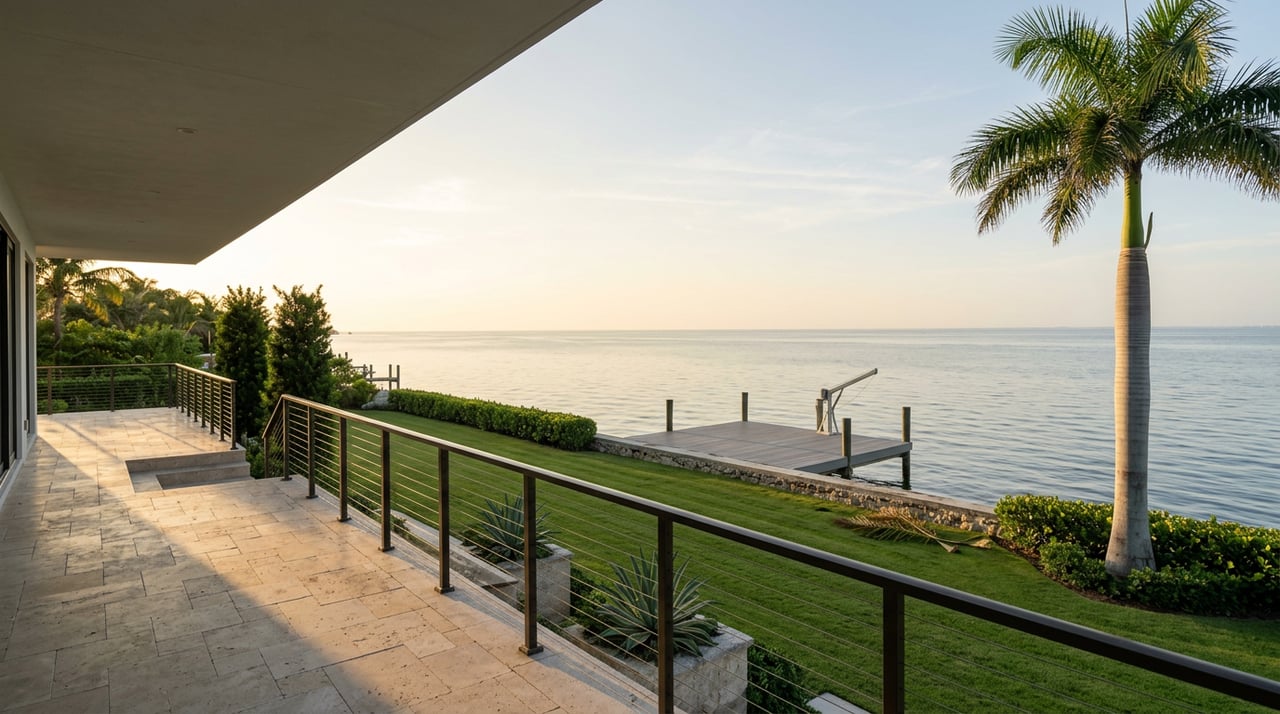
In April 2026, a house at 860 Admiralty Parade E. sold for $40 million. The listing sheet said 177 feet of water frontage, an 11,500-square-foot home completed in 2024, sitting on a lot and a half. On paper, that frontage number looks like the asset. In practice, it is the least useful number in the file.
Naples has gotten used to headlines like this one. As a Business Observer report on the sale put it, big transactions here are common enough that "news of the deals may soon become mundane." What doesn't make the headline is the second number buyers eventually have to reckon with: how much of that frontage is actually buildable, once Port Royal's own dock rules, seawall condition, and association review are applied to it.
That gap between the frontage number and the buildable number is the thing worth understanding before you write an offer in Port Royal, not after.
The Listing Number Isn't the Building Number
Water frontage tells you how wide the lot is where it meets the canal. It does not tell you how far a dock can extend, how many boats you can moor, or whether the structure that's already there was ever permitted correctly. Those answers live in a separate set of rules that apply specifically to Port Royal, not to Naples waterfront generally.
The Port Royal Property Owners Association limits most properties to a single dock "envelope," sized to the maximum allowable dock for that lot, with a required setback of roughly 20 feet from the property line. A homeowner is technically permitted to build up to a 100-foot dock and still meet setback rules, but the association's own staff have flagged that as more dock than the character of the community was built around. In effect, the frontage number and the dock envelope are two different calculations, and a buyer who assumes the bigger number applies to construction is going to be surprised at the plan review stage.
Port Royal Measures From the Rock, Not the Wall
Here is the detail that separates Port Royal from most of the rest of Naples's waterfront. Most canal-front neighborhoods measure dock setbacks from a seawall. Port Royal largely doesn't have seawalls. It has riprap revetments, sloped rock banks rather than vertical concrete walls, and the association has interpreted its own code to mean that no part of a dock or lift may extend more than 22 feet waterward of the toe of that rock, not from the property line and not from an arbitrary point on the bank.
That distinction matters in a very concrete way. A 32-foot boat with a 10.5-foot beam already consumes a large share of the space inside a 22-foot protrusion limit, which means the difference between a dock that clears the rule and one that doesn't can come down to a few feet of rock placement. Renourishment work on that riprap is supposed to restore the bank to its original elevation, not raise it, and the association requires an as-built survey once any repair or dock work is finished. A property without that paperwork on file is not automatically noncompliant, but it is a property where the buyer has no record to check the current structure against.
A Seawall and a Dock Fail Together, Not Separately
Even where a straight wall exists instead of riprap, waterfront due diligence in Port Royal treats the shoreline structure and the dock as one connected system, because they load each other during storms and tidal cycles. A proper inspection checks the cap for cracking and spalling, the tie-back rods and dead-man anchors behind the wall, and the weep holes that are supposed to relieve water pressure without letting soil wash out behind the cap. None of that is visible from a dock tour. A wall can look freshly painted and structurally sound from the water side while losing soil behind it for years.
That is also, by the way, not something a standard flood policy will fix. National Flood Insurance Program coverage, which caps out at $250,000 for the structure and $100,000 for contents on most Naples properties, explicitly excludes seawalls, bulkheads, and docks. A failed wall is a capital repair the owner absorbs directly, which is one reason serious buyers request an engineer's inspection report and repair history as part of the contract, not as an afterthought once due diligence is nearly over.
What Your Insurance Won't Tell You Until You Ask
Flood insurance in Port Royal used to be a simpler conversation: check the FEMA flood zone, check the elevation certificate, get a quote. Under FEMA's Risk Rating 2.0 methodology, the zone and the building's elevation relative to Base Flood Elevation are still part of the calculation, but they are no longer the whole calculation. Replacement cost, distance from water, foundation type, and number of floors all factor into the premium now, which is why two comparable homes on the same street in Port Royal can generate very different flood insurance quotes even when they carry the same zone designation.
Policies that were previously eligible for grandfathered rating are also transitioning toward full-risk premiums under this methodology, so a quote a seller obtained even a year or two ago is not a reliable stand-in for what a new buyer will actually pay. The practical move is to request a current quote against the exact structure, not the parcel, early enough in the contract period that a bad number doesn't surface after the inspection window has closed.
The Association Still Has the Last Word
Even a seawall in good condition and a dock within the setback lines don't guarantee approval on their own. The Port Royal Property Owners Association retains authority to disapprove plans on aesthetic grounds, requires that architects and builders be pre-approved by the association before construction starts, and requires signed and sealed plan sets before anything moves to the city for permitting. That review runs in parallel with, not instead of, City of Naples zoning approval, Coastal Construction Setback Permits for work near the coastal construction control line, and floodplain review for anything in a Special Flood Hazard Area.
A buyer or seller working through a Port Royal transaction is generally better served treating this as a checklist rather than a surprise:
- Confirm the current dock and lift setup matches the survey on file, not just what's visible from the water
- Request the seawall or riprap inspection history, including any association-required as-built surveys
- Get a current flood insurance quote against the specific structure, not a prior owner's policy
- Confirm whether planned dock, lift, or shoreline work will need both association and city sign-off before it starts
None of these steps are unusual for high-value coastal real estate. What's unusual is how often they get compressed into the final days of a closing because nobody flagged them at the offer stage.
Why This Shows Up in the Days-on-Market Number
None of this friction is theoretical. Public market data through June 2026 shows Port Royal homes selling at a median price of $17.0 million over the trailing three months, up 3.6 percent from the same period a year earlier, while the average time on market stretched to 170 days, up from 159 days the year before. Price and pace moving in different directions is not a contradiction. It's what happens when a market has real buyer demand at the top end but every transaction still has to clear a dock survey, a seawall inspection, an insurance requote, and an association review before it closes.
July 2026 data reinforced the same pattern at the very top of the market: all ten of that month's highest-priced Naples sales were concentrated in Port Royal, Old Naples, and Aqualane Shores, the three neighborhoods where this exact stack of dock, seawall, and association rules applies most heavily. The properties that clear that stack cleanly tend to be the ones that hold their price. The ones that don't are the ones that sit.
What This Means If You're Buying or Selling in Port Royal Right Now
If you're a seller, the fastest way to protect your price is to have the dock survey, seawall inspection, and current insurance quote assembled before the property goes live, not after an offer comes in. If you're a buyer, treat the frontage number on the listing sheet as a starting point for the conversation, not the answer to it. The estate at 860 Admiralty Parade E. sold for $40 million with 177 feet of frontage attached to the sale, but the number that mattered to underwriting, permitting, and the buyer's long-term plans for that dock was a different one entirely.
Working through that gap with an agent who already knows where the paperwork lives, and which structures on a given lot need a second look, is often the difference between a listing that sells at a normal pace and one that lingers toward the neighborhood's current 170-day average time on market. Kevin L Fuller works Port Royal transactions on both sides of that gap, from the dock survey to the closing table. If you're evaluating a Port Royal property, or preparing to list one, start with a custom home valuation and a conversation about what the frontage number actually gets you.